Request
Describe symptoms, not solutions. Where it happens, when it started, whether it follows rain or watering. We translate that into what to look at, and we confirm a walkthrough window when we call.
550 Reserve St., Southlake, TX · hello@sundayirrigators.com
About Sunday
Sunday is an outdoor property infrastructure company in Southlake, Texas. Irrigation, drainage, grading, erosion control, privacy fencing and landscape — six disciplines that are really one problem, handled by one accountable team. This page explains how we think, how we work, and what we hold ourselves to.
The rebrand
The name changed because the work outgrew it. “AquaTech” described water. What clients kept asking for was broader than water: the grade behind the pool, the slope losing soil into the creek, the fence leaning because the ground under it moves, the drain that has to exist before new sod is worth installing.
Those requests were never separate jobs. They were one property telling one story. So the company reorganized around the property rather than around a trade, and took a name that could hold all of it.
This is not a coat of paint. It is a change in scope and a change in standard. Scope, because irrigation, drainage, grading, erosion control and fencing are now handled inside one contract by one team, with one person accountable for the outcome. Standard, because that structure only works if the paperwork holds it up: written line-item scope, documented as-builts, testing before handoff, warranty terms in writing.
The trucks, the crews and the phone number are the same. The way the work is scoped, sequenced, documented and verified is what we rebuilt.
 Same crews. Different structure.
Why Sunday
These are not values on a wall. Each one costs us something in the short term, which is the only reason they mean anything.
We do not quote from a photograph or a phone description. Someone comes out, runs the system, opens the boxes, follows the water and finds the cause before anyone discusses price. This is slower than the alternative and it occasionally loses us work to whoever could produce a number that afternoon. We accept that trade, because a quote written without a diagnosis is a guess with a signature line, and the cost of guessing lands on the property owner every time.
Irrigation, drainage, grade and structure are one problem wearing four costumes. A dry patch can be a pressure problem created by a leak; a leaning fence can be a drainage problem; a flooded lawn can be an irrigation schedule. Solving one in isolation usually creates the next one, and the next contractor gets blamed for it. We look at the whole property even when you called about one corner of it, and we tell you what we found in priority order rather than in invoice order.
Every proposal is line-item, with quantities, materials, depths, restoration and explicit exclusions. You should be able to read it and know exactly what will exist when we leave, and exactly what will not. Exclusions get as much attention as inclusions, because that is where surprise lives: rock excavation, permit fees, tree root conflicts, sod restoration, repairs discovered mid-trench. Naming them in advance is less comfortable and much more honest.
If the right answer is smaller than what you asked for, the right answer is still the smaller one.
Depth, slope, material and detailing are chosen for a decade of expansive clay, hundred degree Augusts and the occasional hard freeze — not for the fastest install on the schedule. That means pipe set at working depth rather than shallow, drain runs held to a real fall instead of an optimistic one, posts anchored below the soil’s active zone, concrete crowned so water leaves the post, and pressure regulated at the head rather than tolerated at the meter. None of it is visible when we finish. All of it is visible in year five.
Decisions get made in the interest of the property and the people who use it. Sometimes that means telling you the drainage system you asked for is unnecessary because two downspout extensions and a regrade will do it. Sometimes it means telling you that the repair you wanted is a bad investment on a system that needs a partial rebuild. Either way you get the assessment we would want if it were our house, including the part that reduces the invoice.
One company, one point of contact, one accountable scope across all six disciplines. No coordinating three contractors who each believe the other two caused the problem, and no gap between trades where responsibility disappears. Sequence becomes a plan instead of a negotiation, and when something needs to be made right, there is exactly one number to call.
How we work
The order is the point. Skipping a step is how scopes drift, schedules slip and the same square foot gets paid for twice.
Describe symptoms, not solutions. Where it happens, when it started, whether it follows rain or watering. We translate that into what to look at, and we confirm a walkthrough window when we call.
We walk the property and operate the system. Every zone runs while someone watches it. Boxes and enclosures get opened. Where a recommendation depends on fall, grade is measured rather than estimated. Findings are separated into now, next season, and watch it.
A written plan in priority order, with line items, quantities, materials, depths, restoration and exclusions stated plainly. If phasing the work across two seasons is smarter than doing it all at once, the plan says so and prices it that way.
Utilities located before anything is dug. Scheduled crews, protected site, excavated material staged off turf, daily cleanup, and one point of contact who knows your property throughout. Changes get documented and approved before they happen, not explained afterwards.
We test the result with you present — run the zones, flow water through the drains, load the gates — then document what was installed and set the maintenance rhythm that protects it. You get an as-built or condition record you keep, not a receipt and a handshake.
Standards
Every item below is either done on your project or it is not. There is no interpretation available, which is the entire reason to publish them.
The name
Sunday is the day a property actually gets used. Nobody spends it thinking about valve boxes or fall percentages. They spend it outside, or they spend it wishing the yard were not a project.
So that is the standard we work to: a property that works without asking anything of you. Everything we build underground exists so the surface can be uneventful.
Who we work with
The method does not change with the size of the site. The documentation and scheduling around it does.
A single property treated as a long-term asset, not a service call.
Documented scopes, repeatable schedules and one contact across addresses.
Entries, common areas and the shared drainage nobody owns individually.
Irrigation and drainage designed before the sod goes down, not after.
Grading and drainage planned at the lot level, with buildout in mind.
Campuses and office parks on service agreements with defined windows.
Frontage, islands and parking-lot drainage that has to stay presentable.
Large zone counts, shared water systems and turnover-driven schedules.
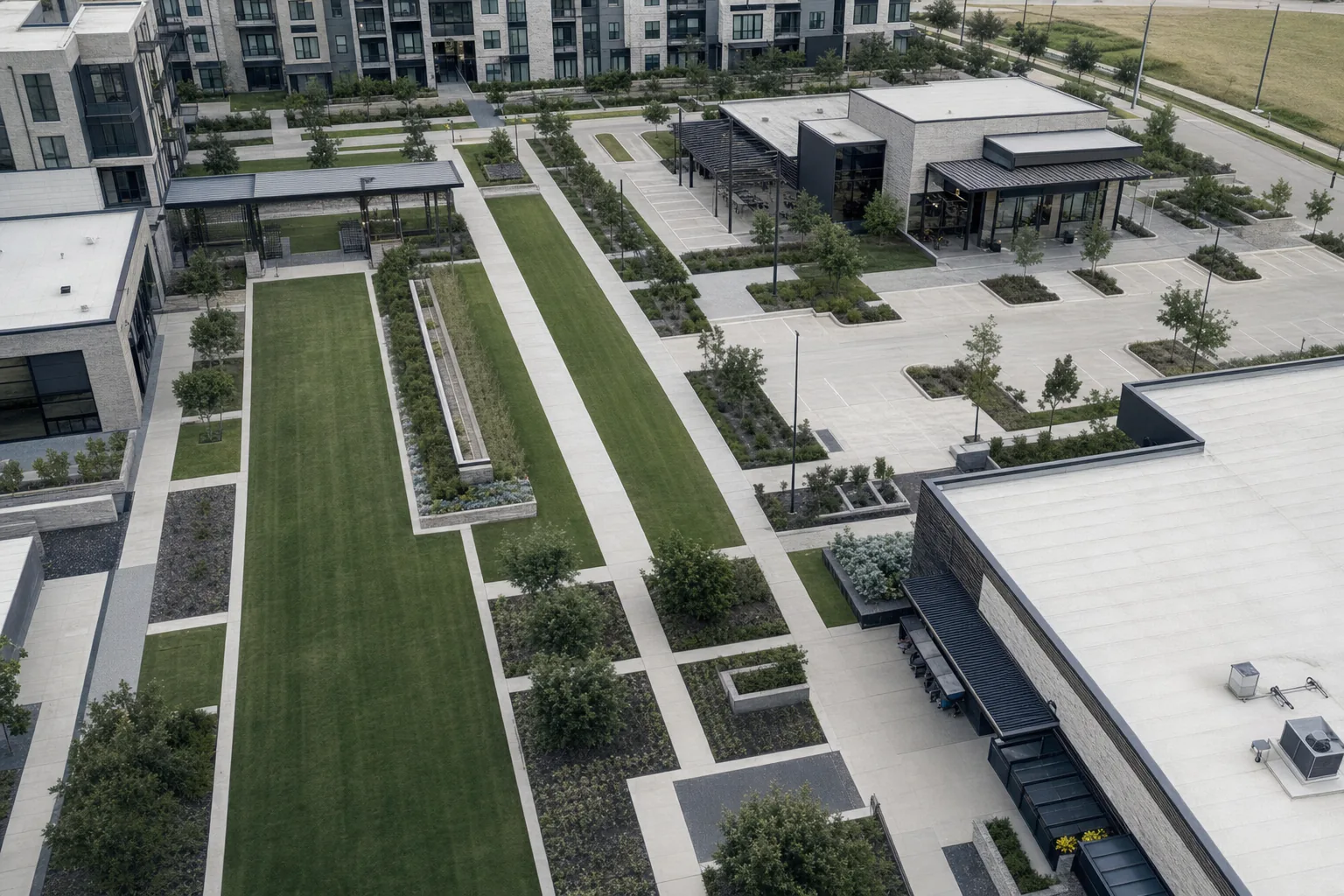 Multi-property work, managed as systems
Where we work
We work where we can be on a property the same week we said we would, and where we already know what the soil does. That is a deliberate limit.
Just outside the list? Ask. We will tell you honestly whether we are the right fit rather than stretch a crew across the metroplex.
Next step
An assessment is the only honest way to evaluate any of this. Describe what you are seeing and we will walk it with you.

Seasonal service
Each fall Sunday adds lighting to the work we already do on your property — permanent architectural systems that stay on the roofline year-round, and seasonal holiday installs we hang, service and take down for you.
All lighting installations booked before November 1. Design and quote at no charge.
Discount applies to new lighting installations scheduled between September and January. Ask us about bundling with a maintenance plan.
WAIT—DON'T PAY FULL PRICE.
Get 25% off your next Sunday project.
Drop your email below and we’ll send your offer.
New customers only. Terms apply.
YOU’RE IN.
Your 25% Sunday offer is on its way.