Rainfall does not damage property. Rainfall with nowhere to go does.
A two-inch rain over a typical North Texas lot is not a weather event. It is a volume
problem with a destination problem attached. Sunday surveys where the water comes
from, where it collects and where it is legally allowed to go — then builds the route.
Almost nobody calls us about drainage. They call about a soft corner of the lawn, a
patio that stays wet, mulch in the driveway, or a smell in the side yard. The first
job is arithmetic: how much water lands on this property, and where does each part of
it come from.
One inch of rain puts about 0.62 gallons of water on every square foot it touches. A
2,400 square foot roof therefore sheds roughly 1,500 gallons in a one-inch rain, and
roughly 3,000 gallons in a two-inch rain — and it does not release that water evenly.
It concentrates it at four or five downspouts. Add the driveway, the patio, the
sidewalks and whatever arrives from uphill, and a modest lot can be handling several
thousand gallons in under an hour.
That is why "it only floods when it rains hard" is a description of the problem, not
an excuse for it. The system is not failing at the average rain. It is failing at the
rain that matters. We size for the second one.
North Texas soil makes the arithmetic worse. Tight clay subsoil accepts water slowly,
and once the top few inches are saturated, infiltration effectively stops. From that
moment everything is surface flow, and surface flow obeys grade — not intentions.
Roof area and downspoutsHighest volume, most concentrated
Driveway, patio, walksSheet flow, near zero absorption
Neighboring gradeWater arriving, not falling
Low points and swalesWhere volume becomes standing water
Compacted clayInfiltration stops early in a storm
Irrigation overrunKeeps a low spot saturated between rains
Pool decks and equipment padsBackwash and rinse volume
We measure elevations at the structure, the property line, the hardscape edges and
every candidate outfall. The design follows the survey. It is the only order that
works.
02
Anatomy
What a routed lot looks like underground.
Roof water gets captured, carried, collected at the low point, filtered through a
gravel envelope and released downhill by gravity. Every element exists to keep water
moving in one direction.
Drainage cross-section · downspout to outfall
Collection, conveyance, interception and release. Component depths and fall are set
by the elevation survey; the sequence does not change.
03
Scope
Systems we build.
Most properties need two or three of these, not all of them. The design decides which
— and says plainly which ones you do not need.
Surface grading and positive fallFirst move, cheapest move
Downspout tie-insRoof volume buried and carried
Catch basins and inletsAt low points and swale ends
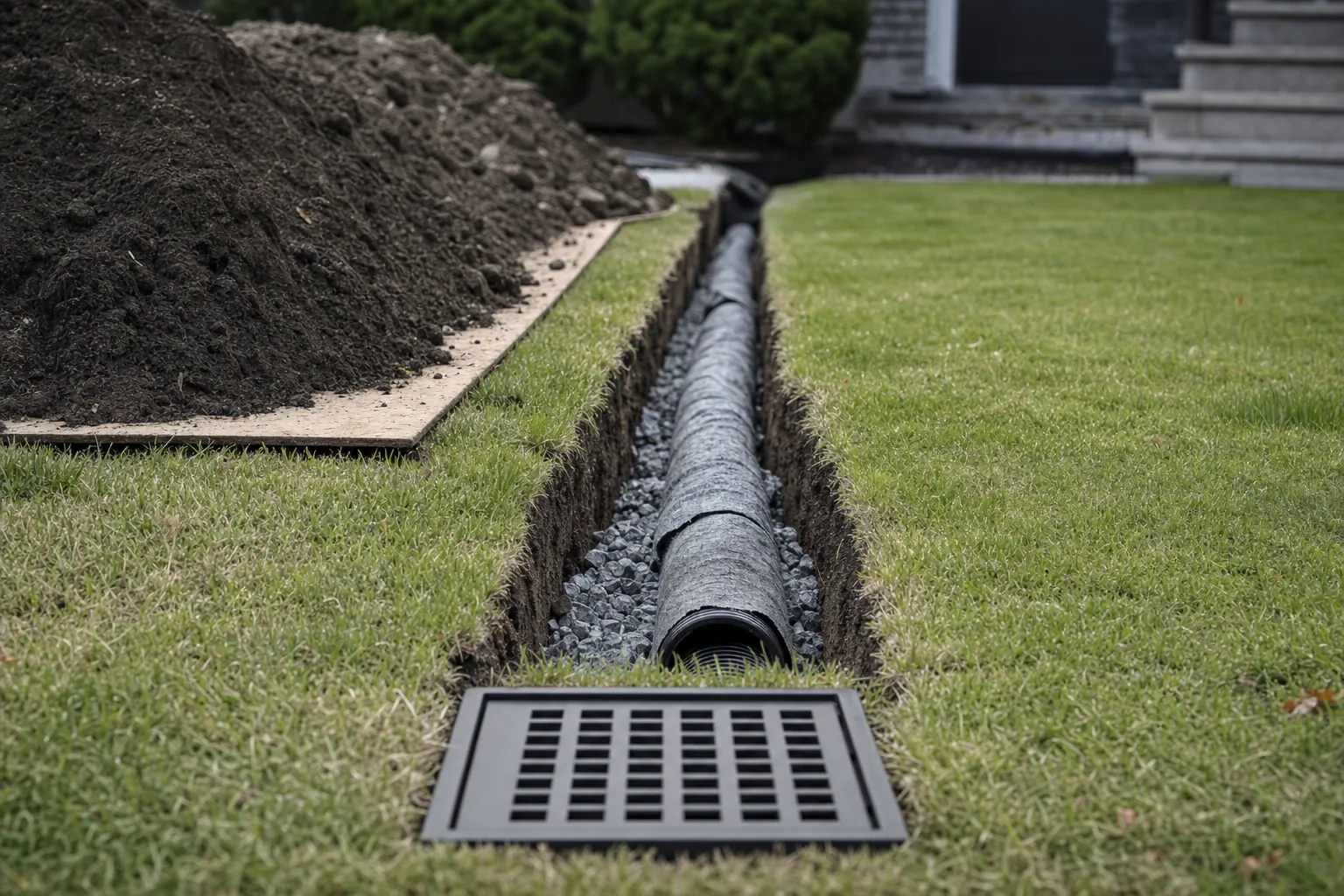
French drainsPerforated pipe, gravel, fabric
Channel and trench drainsAt driveways, patios, garage aprons
Dry creek bedsVisible conveyance, armored
Sump systemsOnly where gravity fails
Subsurface drainage under turfFor fields and flat lawns
Outfalls and pop-up emittersLegal, visible release point
Turf and hardscape restorationPart of the scope, not extra
01
Grade before pipe
If two inches of dirt in the right place solves it, we say so and we do that instead.
02
One direction, no low spots in the line
A pipe with a belly in it is a silt trap. Fall is verified as the trench is cut, not after.
03
The outfall decides the design
We find the legal release point first. Everything upstream is drawn back from there.
04
Selected work
Same yard. Different routing.
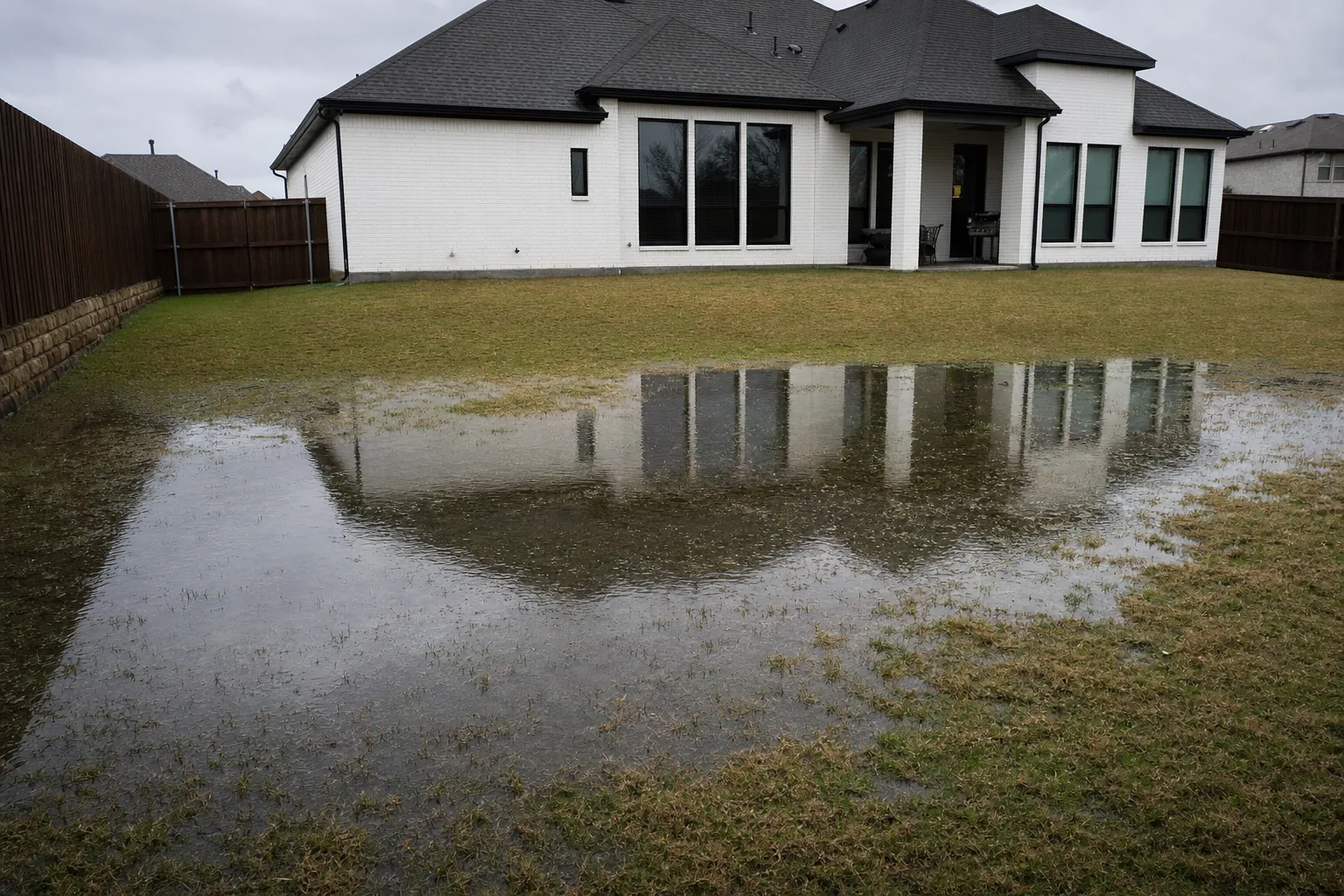
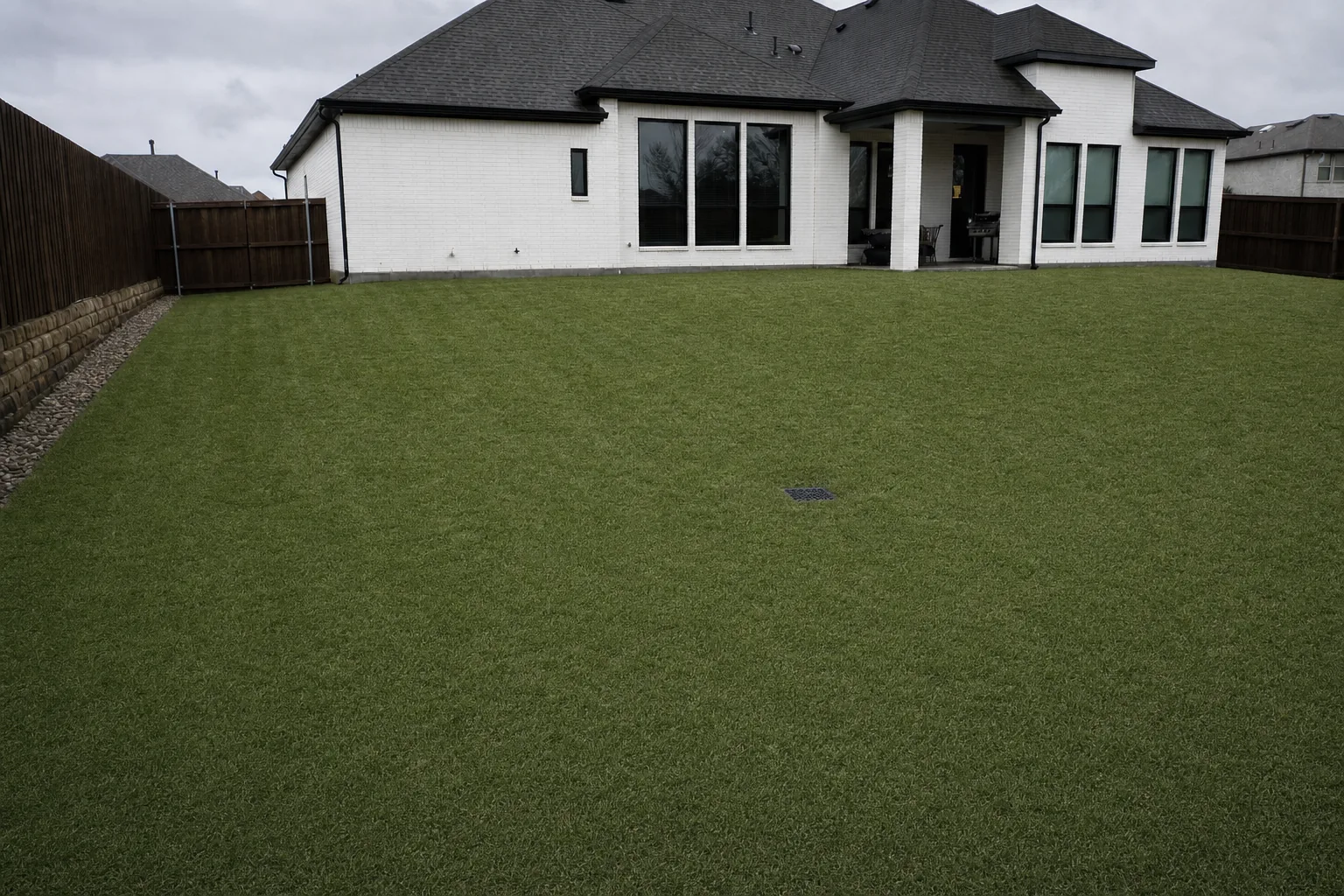
Drag the slider. Nothing about the rainfall changed between these two photographs.
BeforeAfter
Southlake, TXDrainage · Grading
Rear Yard Collection and Outfall
Problem
Water stood across the rear lawn for days after every rain, with moisture holding
at the patio edge and along the base of the fence.
Assessment
The elevation survey showed almost no fall behind the house and four downspouts
discharging within a few feet of the same low corner. The turf was reporting a
routing failure.
Solution
Regraded for positive fall, tied every downspout into a buried rigid collection
line, set catch basins at both low corners, and ran a gravel-wrapped French drain
to a daylight outfall in the side yard.
Outcome
Surface water clears within hours instead of days, the patio edge stays dry, and
the fence line is no longer sitting in saturated soil.
Just having a pipe in the ground doesn’t mean it’s draining.
The difference between a drain that works for fifteen years and one that silts shut in
two seasons is entirely in the trench, and none of it is visible once the sod goes
back down. This is the part worth asking every contractor about.
01
Non-woven geotextile, lapped
Fabric separates clay from stone. Without it, fines migrate into the voids and the envelope stops conducting water.
02
Washed angular stone, not screenings
Angular stone locks together and holds open void space. Rounded pea gravel and fine screenings pack tight and choke.
03
Pipe class matched to duty
Perforated pipe inside the envelope where the job is collection; rigid smooth-wall for conveyance, so it flows clean and can be cleaned out.
04
Fall shot, not eyeballed
Continuous fall of at least one percent, checked along the run. A single flat section undoes everything upstream of it.
This is the part of drainage that has nothing to do with your lawn. It is why we treat
water at a foundation as a structural question rather than a landscaping one.
Much of the DFW area sits on expansive clay. These soils take on water and swell, then
give it up and shrink. The movement is vertical and it is not uniform across a lot,
because one side of a house is shaded, one side gets the roof discharge, one side has
a bed on a drip line and one side bakes.
A slab does not mind moisture. It minds differential moisture, and it
especially minds the cycle: saturated for a week after every storm, then desiccated
through a stretch of hundred-degree days. That repeated shrink and swell at the
perimeter is what moves corners, opens brick joints and sticks doors.
So the fix is not more water and it is not less water. It is stable water. Route the
storm volume away from the perimeter so the soil is never soaked, and keep the
perimeter from going bone dry in August so it is never fully shrunk. Drainage does the
first half. Irrigation, tuned properly, does the second.
Roof discharge carried well past the perimeter, not splashed beside it
Positive fall for the first several feet out from the wall, in every direction
No planting bed built up against the brick, holding water at the slab edge
No irrigation head throwing directly onto the foundation line
Deliberate summer moisture at the perimeter instead of accidental drought
Sunday is not a foundation repair company. We manage the water that acts on soil. If a
property needs structural evaluation, we will tell you that and stay in our lane.
06
Questions
Drainage, answered directly.
They are usually the same problem. Grading decides where water goes on the surface; drainage carries what grading cannot move. If water stands in a broad shallow sheet, the grade is flat or reversed. If water moves but arrives somewhere it should not, the routing is wrong. We survey elevations before deciding which one you are paying to fix.
On a lot with positive fall and somewhere for water to go, surface water should be gone within hours of the rain stopping. Water that sits for a day or more is not a soil condition to wait out. It means the low point has no outlet.
No. A French drain intercepts water moving through soil and needs somewhere lower to release it. If the yard is flat, or the water is sheet flow off a patio, or the roof is dumping thousands of gallons into one corner, a French drain alone will underperform. It is one component, not a strategy.
Somewhere lower that legally accepts it: a street, an alley, a swale, a drainage easement, or a point on your own property where discharge does not concentrate onto a neighbor. Outfall availability is the single biggest constraint on a drainage design, and it is the first thing we look for. Where no gravity release exists, the answer becomes a sump system, which changes both the cost and the maintenance picture.
We will not publish a price for work we have not surveyed, because the same symptom can be a one-day tie-in or a full rear-yard rebuild. What drives the number is straightforward, and you should ask any contractor to break it out this way: linear footage of pipe, trench depth, whether a gravity outfall exists or a sump is required, the number of hardscape crossings that have to be cut and restored, basin and inlet count, and how much regrading and turf restoration follows the excavation. You get a line-item scope with quantities before anything is dug.
Sometimes. If water on one side of a slab has to reach an outfall on the other, the options are a saw-cut crossing, a channel drain at the edge, or boring underneath. We price the crossing and the restoration as their own line items so you can see exactly what that decision costs and choose knowingly.
Both, for different jobs. Rigid smooth-wall pipe carries collected water with less friction and can be cleaned out properly, so we use it for downspout collection lines and long runs. Perforated pipe belongs inside a gravel envelope where the job is to collect water from soil rather than transport it. The failure we see most often is thin corrugated pipe used as a mainline, then crushed by traffic or silted shut.
Basins and grates need clearing of leaf litter and silt, outfalls need to stay open, and pop-up emitters need to seat properly. That is most of it. Full Season maintenance members get drainage inspection and basin clearing included, which is mostly about finding a blocked outfall before the next heavy rain finds it for you.
Next step
Tell us where the water goes.
Describe what you see and when you see it — the corner that stays soft, the day the
patio floods, the downspout that has been eroding the same spot for two years. A
Sunday specialist will walk the property, shoot elevations and come back with a
written scope.
AssessmentOn-site, no obligation
You receiveLine-item scope with quantities
Also usefulPhotos of the yard mid-rain
Water actively moving toward a structure gets triaged ahead of routine work. If that is
your situation, call (817) 320-0028 rather than waiting
on a form.
Request a drainage assessment
Tell us what you’re seeing. We’ll tell you what’s causing it.
Request received.
A Sunday specialist will reach out to schedule your assessment and walk the
property with you. If it’s urgent, call
(817) 320-0028.
Drainage
Water is going somewhere. Decide where.
Every storm that leaves your lot the wrong way takes soil, grade and eventually
structure with it. Routing is the cheapest work we do.
Legal outfall identified before the design is drawn
Fabric, stone and pipe class stated in the scope
Restoration priced as part of the job, not after it
September – January
Seasonal service
Lighting, done at the same standard as everything else.
Each fall Sunday adds lighting to the work we already do on your property — permanent
architectural systems that stay on the roofline year-round, and seasonal holiday installs we
hang, service and take down for you.
Permanent low-profile LED channel, color and scene control from your phone
Holiday installation, mid-season service and January takedown included
Landscape and architectural uplighting on trees, stone and entries
Measured, wired and set by the same crew that handles your irrigation
25% off
All lighting installations booked before November 1. Design and quote at no charge.
 Before
After
Before
After