Walk & survey
How water moves across the property, where sun actually falls, what stays and what has to go.
550 Reserve St., Southlake, TX · hello@sundayirrigators.com
Service · 06
Stone, planting and lawn are the part of a property everyone actually looks at. They are also the first part to fail when the ground and the water underneath them are wrong. Sunday designs landscapes from the grade up, with the drainage and the irrigation drawn at the same time as the beds.
Failure modes
Almost every landscape we are asked to rescue was installed correctly at the surface and incorrectly underneath it. Six causes account for most of it, and they compound.
Beds and lawn were shaped by a builder to move dirt, not water. Everything planted on top of that inherits it — wet corners, dry ridges and a bed that drains toward the house.
Turf and planting beds want different water, delivered differently. On a shared zone one of them is always wrong, and it is usually the beds that pay for it.
Compacted clay does not become a planting bed because a hole was dug in it. Roots stall at the edge of the amended hole and the plant spends years never getting established.
A west-facing bed in August is a different climate from the shaded side of the same house. Plant lists that ignore that produce a two-season landscape.
Flagstone and pavers move because of what is under them. Base depth, compaction and fall are invisible in a photograph and decisive in year three.
The first two summers decide whether new planting survives. A landscape handed over without a watering schedule is being handed over half finished.
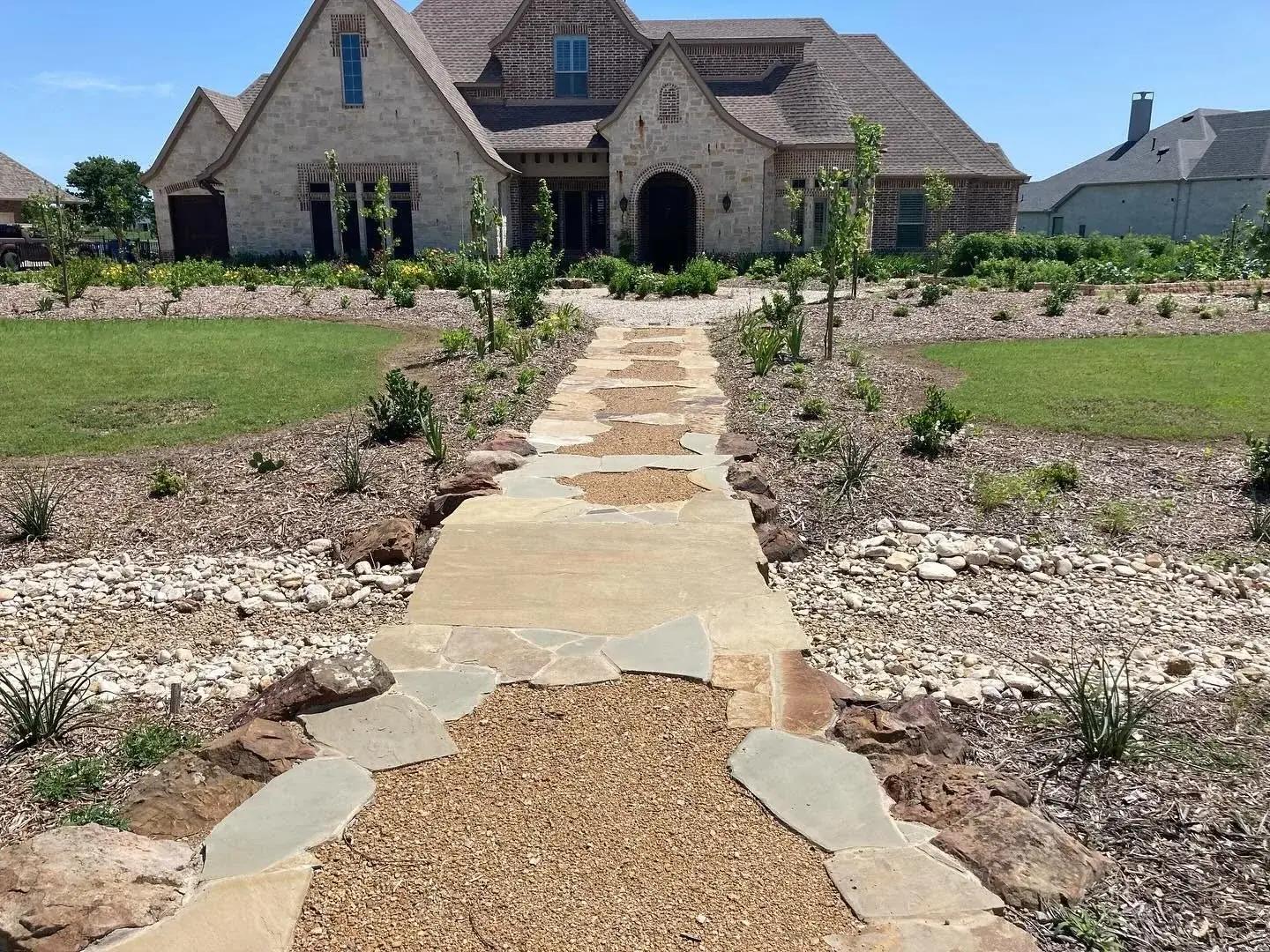 Walk, beds and rock course set after the grade was corrected
Scope
We do not sell hardscape, planting and irrigation as separate visits. They are one system, and the seams between them are where landscapes usually fail.
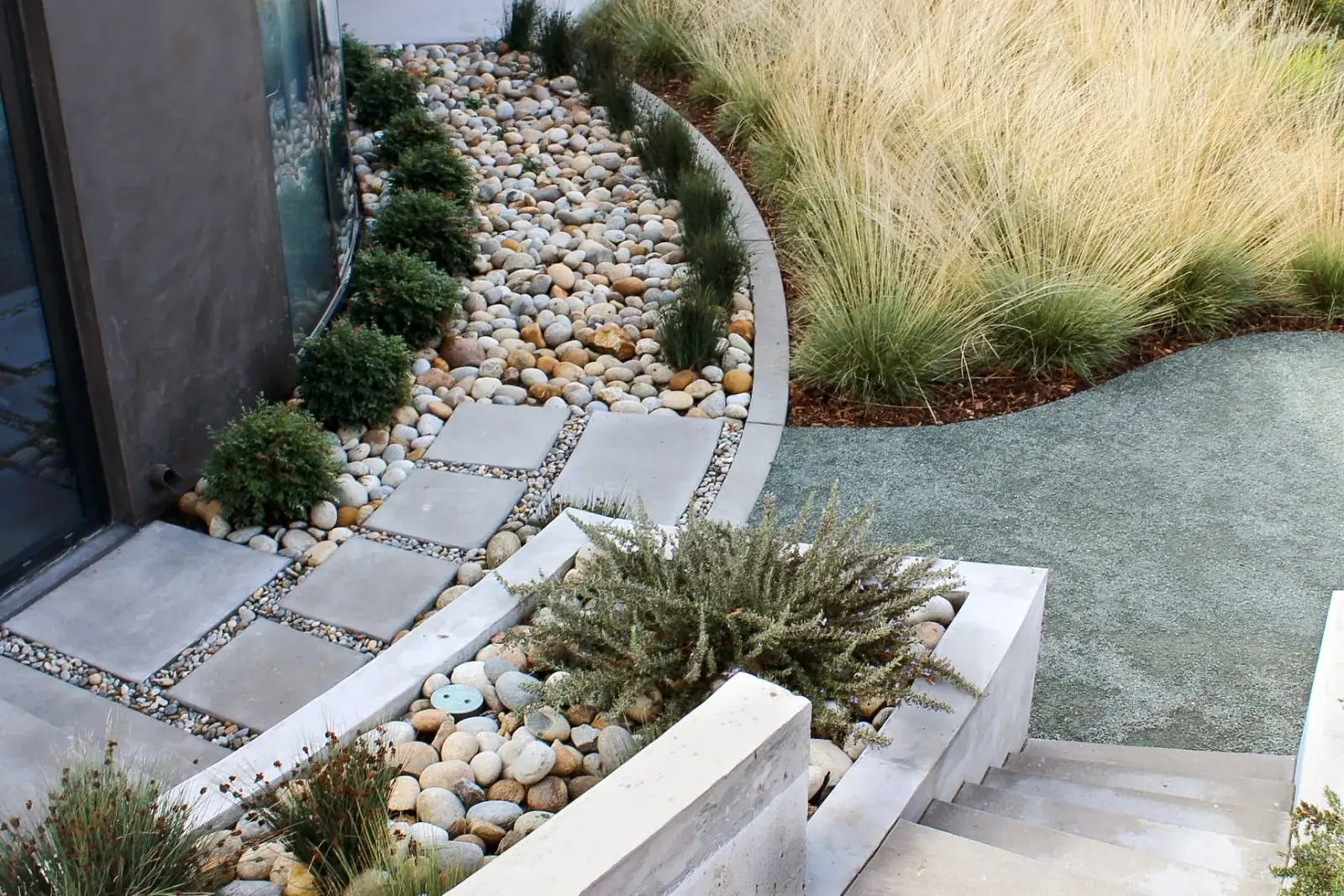 Stone, planting and the surface that carries water, drawn as one detail
The permanent geometry of a property: where you walk, where you sit, where the ground changes level. All of it built off a prepared, compacted base set to a deliberate fall.
Structure first, color second. Trees and evergreen mass do the architectural work; perennials and grasses are what change through the year without being replaced every year.
The layer nobody photographs and everybody feels. Grade, soil and irrigation are what decide whether the two layers above them are still worth looking at in five years.
A landscape project is often the cheapest moment to fix everything else, because the ground is already open and the crew is already there. It is also perfectly reasonable to do it in stages, and we will tell you which stage genuinely has to come first.
Build sequence
Eight steps, in this order. Anything set before the grade and the water are right has to be lifted later to fix them.
How water moves across the property, where sun actually falls, what stays and what has to go.
Where the ground itself has to change. Nothing is set or planted on a grade we would not sign off on.
Collection points and carry lines placed before beds and hardscape sit on top of them.
Zones drawn to planting type. Drip on beds, spray or rotors on turf, controller programmed to match.
Base excavated, compacted and set to fall. Stone, pavers and walls built off that base.
Beds decompacted and amended as beds, not as a series of individual holes.
Trees first, evergreen structure next, perennial and detail planting last. Mulch and edging to finish.
A written watering schedule for the first season, the controller set to it, and adjustments as roots take.
Planting and water
A planting plan is a watering plan whether or not anyone writes it down. Beds and turf on the same zone means one schedule serving two completely different demands, and in a North Texas August that difference is the whole outcome. Spray heads throwing water over shrub beds lose most of it to evaporation and wet the foliage rather than the roots.
So we group planting by how much water it actually wants, put beds on drip, keep turf on its own zones, and set the controller to the plan rather than leaving it on the default it shipped with. It is the difference between a landscape that establishes and one that is quietly replanted every spring.
Surfaces
There is no single best surface. There is a right one for the traffic it carries, the architecture it sits against and the water it has to let through or shed.
| Consideration | Flagstone | Concrete pavers | Decomposed granite |
|---|---|---|---|
| Character | Irregular, natural | Uniform, modular | Soft, informal |
| Walking surface | Varied, hand-set | Most even underfoot | Loose, not for heels |
| Lets water through | At the joints | Depends on joint | Yes, when built right |
| Vehicle traffic | Not typically | Yes, with a drive base | No |
| Repairability | Reset by the piece | Lift and replace units | Top up and recompact |
| Maintenance | Joints and weeds | Joint sand, edging | Periodic replenishment |
| Relative cost | Higher | Mid to higher | Lowest |
| Typical Sunday use | Walks, terraces, steppers | Terraces, motor courts | Garden paths, side yards |
The parts that never appear in a photograph are the parts that decide whether the surface is still flat and still draining in year five.
Any wall holding soil is holding water as well. That is a drainage detail with stone on the front of it, which is why walls are engineered here rather than stacked.
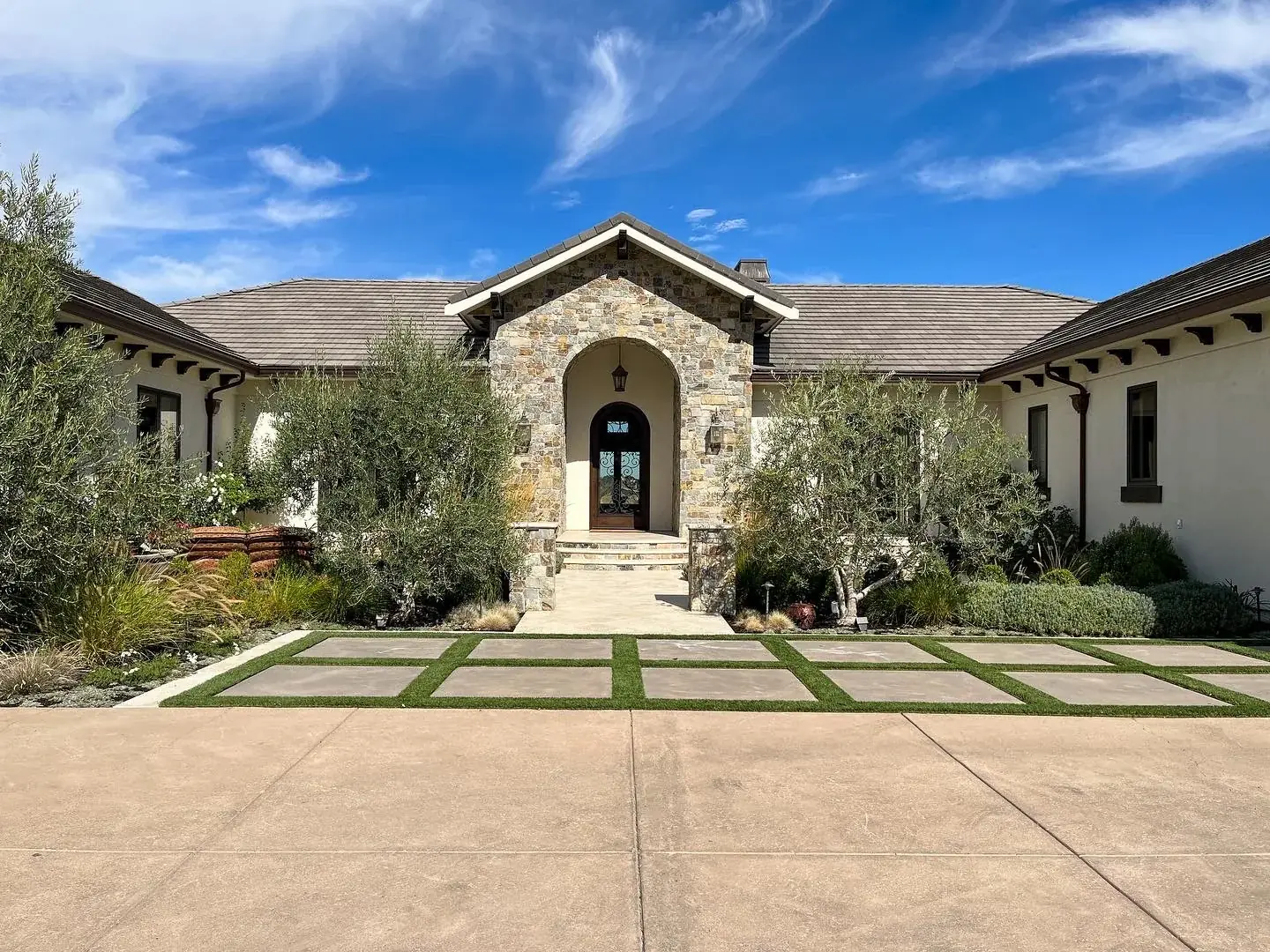 Arrival built from paving, trees and one repeated interval
Front elevation
Arrival is mostly geometry: the interval of the paving, the line of the walk, the height of what sits either side of the door. Get those right and the planting can be simple. Get them wrong and no amount of color rescues it.
We work the front elevation as a sequence rather than a bed list — drive, walk, entry, and what each one frames. Lighting is planned into the same drawing, because the front of a house is looked at just as often after dark.
After the install
New planting spends its first season deciding whether it is going to live. Root systems have to move out of the nursery ball and into the bed, and the amount of water that requires changes month by month. Most new landscape loss happens in that window, and almost all of it is water — too little, too often, or in the wrong place.
So the handover includes a written schedule for the first season, the controller already programmed to it, and a check back once the weather turns. If you would rather not think about it at all, the same work can sit inside a Sunday maintenance plan.
 Structure planting carries a garden between seasons
Questions
Both. Most Sunday landscape projects start with a walk and a plan: where water goes, where sun falls, what stays and what has to change at the grade. We can work from a designer or architect's drawings as well, and we will tell you honestly where a drawing conflicts with how the site actually drains.
That is the order we prefer. Beds, walks and walls sit on top of the grade, the drainage and the irrigation, so the cheapest moment to correct any of those is before the stone and the plants are set. Doing it in one mobilization also means one crew, one schedule and one point of contact.
Usually because it was planted into compacted builder clay, watered by a turf zone, and chosen for how it looked at the nursery rather than for the exposure it ended up in. Amended and decompacted beds, drip on the beds instead of spray, and plants matched to sun and water are what change the outcome.
Yes. Turf and planting beds want different amounts of water delivered in different ways and at different frequencies. Putting them on one zone guarantees one of them is wrong, and normally it is the beds. Where we are already touching the system, we separate them and put the beds on drip.
Flagstone, cut and quarried stone, concrete pavers, decomposed granite, boulders and poured concrete, plus stone-faced and board-formed walls. The choice is driven by the architecture, the traffic the surface has to carry and the base it can be built on, not by a preferred product.
Both. We install and renovate turf, and we also reduce it. Pulling turf back to where it earns its water and replacing the rest with beds, stone or low-water massing usually improves both the look and the water bill, particularly on hot western exposures.
New planting has an establishment period, and it is the phase most often skipped. We hand over a watering schedule for the first season, set the controller to match it, and adjust as the plants root in. Ongoing care can be folded into a Sunday maintenance plan.
We locate public utilities before any machine breaks ground, and we flag the requirements that apply to your address. Many neighborhoods have review rules on walls, structures, tree removal and front-yard planting; we build to the approved detail rather than asking forgiveness later.
Next step
Tell us which areas you want to change, what you already dislike about how the ground behaves after rain, and whether this is a full property or a single elevation. If there is a drawing, send it. If there is not, that is fine — most projects start with a walk.
If the irrigation or the drainage needs correcting first, we will say so before we quote the planting rather than after.
Request a landscape assessment
Areas, ambitions and what the ground does after rain. We’ll scope the rest.
A Sunday specialist will reach out to schedule your assessment and walk the property with you. If it’s urgent, call (817) 320-0028.
Landscaping
Grade, drainage, soil and water. Get those four right and the stone and the planting on top of them get to look good for a very long time.

Seasonal service
Each fall Sunday adds lighting to the work we already do on your property — permanent architectural systems that stay on the roofline year-round, and seasonal holiday installs we hang, service and take down for you.
All lighting installations booked before November 1. Design and quote at no charge.
Discount applies to new lighting installations scheduled between September and January. Ask us about bundling with a maintenance plan.
WAIT—DON'T PAY FULL PRICE.
Get 25% off your next Sunday project.
Drop your email below and we’ll send your offer.
New customers only. Terms apply.
YOU’RE IN.
Your 25% Sunday offer is on its way.