Run the system by zone
Every zone, start to finish, watched in the yard — not just the one you called about.
550 Reserve St., Southlake, TX · hello@sundayirrigators.com
Service · 01
Dry patches, a dead zone, a corner of the yard that never dries out — those are what you can see. The cause is a pressure number, a leaking diaphragm, a sheared lateral or a program nobody has opened in four years. Sunday runs the system and finds the cause before anyone quotes a part.
Symptom and cause
Homeowners describe irrigation problems in pictures. We translate those pictures into the three things that actually fail: water pressure, the valve and its wiring, or the head itself. Here is how the common ones usually read.
Coverage, not disease. Heads are throwing short of each other, usually from low pressure or a nozzle that does not match the spacing it was installed at.
Almost always electrical or valve-side: a burned solenoid, a corroded field splice, a broken common wire, or a diaphragm that will not lift.
The head sheared off its riser — mower, truck tire, or a rigid connection with no give. The repair includes the joint, not just the head.
A valve that is not seating. Water weeps past the diaphragm and the zone runs at a low, constant flow that never shows up on the controller.
Either a lateral leaking underground, or low-head drainage: the whole zone emptying through the lowest head on the run every time it shuts off.
Suspect the mainline. It sits upstream of the valves and stays pressurized around the clock, so a break there leaks whether the system runs or not.
Pressure above what the nozzle was designed for. Misted water drifts and evaporates; the fix is regulation at the head, not a bigger nozzle.
Grit in the wiper seal, a tired retract spring, or a zone starved for pressure because something else on the line is losing water first.
None of these are diagnoses on their own. Two properties can show the same brown stripe and need entirely different work — one needs a nozzle change, the other needs twelve feet of lateral replaced. That is the whole argument for measuring first.
Where things fail
Water leaves the meter, passes the backflow assembly, and sits in the mainline under pressure all day. Valves release it into laterals. Laterals feed heads. Every irrigation failure lives at one of those three points — and where it lives determines what it costs.
A head is a twenty-minute repair. A valve is an hour with a shovel. A mainline break is a pressurized excavation. Knowing which one you have before the truck is loaded is the difference between a repair and a project.
The visit
Same order, every property. The point is to leave knowing the cause of what you called about and the condition of everything you did not.
Every zone, start to finish, watched in the yard — not just the one you called about.
Static and dynamic readings near the point of connection. Most coverage complaints end here.
Boxes opened, solenoids tested, splices inspected, controller output checked station by station.
Arc, nozzle match, spacing, tilt, seal, retraction, and where spray is hitting hardscape instead of soil.
Cause, line-item options, what we would do now, what can wait, and what we are deliberately not doing.
Scope
Everything between the point of connection and the last nozzle on the last zone. We carry the common failure parts, and we replace like with better where the original choice is what caused the failure — a rigid riser under a mower path, a nozzle that never matched its neighbours.
If a system is past the point where repairs make financial sense, we will say so and show the math rather than sell you a fifth patch. That conversation usually leads to a designed replacement.
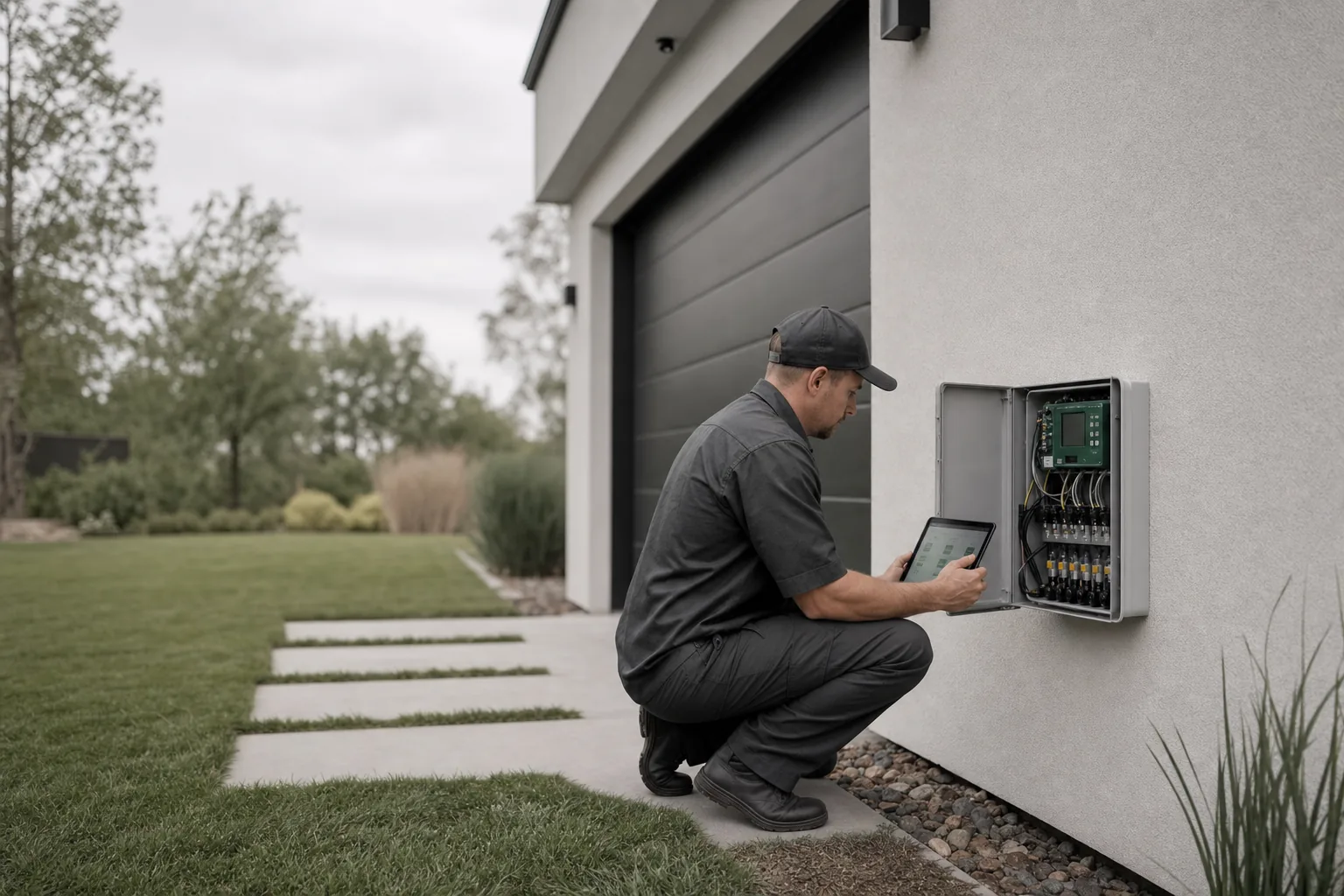 Station-by-station output testing at the controller
Controllers & programming
A large share of the systems we are called out to diagnose are mechanically sound and programmed against themselves. Stations are mapped to the wrong zones, so the shady bed gets the schedule written for the west-facing lawn. Run times were inherited from whoever set the controller up and never revisited. A rain sensor is wired in and bypassed at the switch.
We label every station to the zone it actually operates, then write it down.
Clay takes water slowly. Three short cycles put down what one long cycle sends to the curb.
One schedule cannot serve March and August. We set the adjustment and show you the screen.
Heads & matched precipitation
A zone runs for one length of time. Every head on it is watering for exactly that long. If a rotor putting down a slow, heavy stream shares a valve with a spray head emitting several times faster, one part of the zone is drowning by the time the other is merely damp. You water to the driest head, and the rest of the zone pays for it.
Matched precipitation means every head on a zone applies water at a comparable rate, so a single run time is honest across the whole area. Rotors go with rotors. Sprays go with sprays. Turf does not share a valve with shrub beds. When we find a zone that mixes them, re-nozzling is often cheaper than the water being wasted.
 Nozzle selection decides where the water lands
North Texas conditions
The expansive clay under most of Tarrant and Denton County swells when it is wet and shrinks when it is not. Over a summer it can open cracks wide enough to swallow a hand. Buried pipe does not move with it. Laterals get pulled at fittings, glued joints crack, and swing joints that were installed rigid shear off at the riser. This is why a system that was fine in April develops two leaks in August without anyone touching it, and why we look at joint detailing rather than just gluing the same connection back together.
July is the worst possible time to learn what your pressure actually is. Municipal supply sags at peak demand, everyone in the neighbourhood is on the same early-morning schedule, and a system that reads fine at noon in April can be running well below its nozzle requirement at 5 a.m. in August. Under-pressured heads throw short and leave the dry rings between them. Over-pressured heads mist, and misted water is gone before it lands. Both are pressure problems and neither is fixed by adding run time.
North Texas gets hard freezes, and they arrive fast. Backflow assemblies typically sit above grade, which makes them the most exposed component on the whole system. Water trapped in a brass body expands, cracks the casting or splits a bonnet, and the failure often is not discovered until the system is turned on in spring and the assembly is pouring water. Insulation helps. Draining and shutting down properly helps more. If an assembly has already cracked, it gets replaced — a cracked body cannot be patched back into a test-passing condition.
Most cities in this area require the backflow assembly protecting an irrigation system to be tested by a licensed backflow assembly tester and the results filed with the water department, generally on an annual cycle. Requirements and deadlines vary by city, so confirm with yours. It is a small item that turns into a compliance letter when it is missed, and it is the sort of thing a maintenance plan exists to keep off your calendar.
Most emergency repairs in this market were a five-dollar part in March.
Sunday Maintenance
Nearly everything on this page starts small and stays cheap if someone looks at it on a schedule. Seasonal inspections catch the weeping valve before it floods a bed, the cracked nozzle before it burns a stripe into the lawn, and the backflow assembly before the first freeze finds it. Members also pay 20% less on repairs when something does need fixing.
Questions
It depends entirely on which of the three failure families you have, and nobody can tell you honestly over the phone. A nozzle and a head is a small line item. A valve rebuild is a larger one. A mainline break is an excavation. We diagnose first, then give you written line items with quantities so you can see what each number covers and decide what to do now versus later.
Yes. Most systems we repair were installed by someone else, often years ago, sometimes with no records at all. Part of the visit is building the map that should have been handed over on day one: which station runs which zone, where the manifolds are, and what the system was designed to do.
A broken head shows up only while its zone is running. A leak that runs when nothing is scheduled points upstream, to the mainline, which stays pressurized around the clock. A quick check: with the controller off, watch the meter dial. If it is moving and no fixture inside is running, water is escaping somewhere it should not be.
When every zone is dead, the cause is usually shared rather than local: no power or a failed transformer at the controller, a broken common wire, a closed isolation valve at the backflow, or a master valve that is not opening. Those are quick to isolate in the field and worth checking before anyone digs.
Irrigation installation and repair in Texas is regulated, and the work must be performed by or under the supervision of a licensed irrigator, with the license number shown on estimates and contracts. Ask for it. Any company unwilling to give you a license number has told you something useful about the rest of their work.
Most North Texas cities require a test by a licensed backflow assembly tester on an annual cycle, with the report filed with the water department. Exact requirements vary by city, so confirm with yours. We can perform the test and handle the paperwork as part of a maintenance plan rather than leaving it to a reminder letter.
Usually we can narrow it to a few feet before a shovel comes out. Isolating zones, watching pressure behaviour, reading the meter with individual valves open, and following the surface evidence normally localises a break well enough that the excavation is a small, targeted opening rather than a trench across the lawn.
When the design is the problem. If zones were laid out wrong from the start, mixing turf and beds on one valve or spacing heads beyond their throw, every repair is money spent to keep a bad plan alive. Repeated lateral failures on brittle old pipe point the same direction. We will tell you when the number is better spent on a designed replacement.
Request a diagnosis
Symptoms are enough. You do not need to know whether it is a valve or a lateral — that is the part we are for. Describe what the yard is doing and we will run the system and tell you what is causing it.
Request a sprinkler diagnosis
We will contact you to schedule a visit and walk the system with you.
A Sunday specialist will reach out to schedule your assessment and walk the property with you. If it’s urgent, call (817) 320-0028.
Next step
One visit, every zone run, pressure measured, findings in writing. Then you decide what gets fixed and in what order.

Seasonal service
Each fall Sunday adds lighting to the work we already do on your property — permanent architectural systems that stay on the roofline year-round, and seasonal holiday installs we hang, service and take down for you.
All lighting installations booked before November 1. Design and quote at no charge.
Discount applies to new lighting installations scheduled between September and January. Ask us about bundling with a maintenance plan.
WAIT—DON'T PAY FULL PRICE.
Get 25% off your next Sunday project.
Drop your email below and we’ll send your offer.
New customers only. Terms apply.
YOU’RE IN.
Your 25% Sunday offer is on its way.