Regrading and slope reduction
The cheapest stabilization is a gentler slope. Where there is room, we lower the gradient and lengthen the run before adding anything structural.
550 Reserve St., Southlake, TX · hello@sundayirrigators.com
Service · 04
Nothing collapses. Nothing floods. A slope simply gets a little shorter every year, and the material that leaves it does not come back. By the time it looks like damage, it has usually been running for several seasons.
Diagnosis
Erosion rarely announces itself. It reports quietly, through details that read as cosmetic until you understand what they mean. Every item on this list is evidence of water moving faster than the surface can survive.
Walk your slope the morning after a storm rather than a week later. Fresh, sharp edges mean the process is still active. Rounded, weed-colonized scars mean it has stalled — for now.
Hydraulics
Soil does not leave because water touches it. Soil leaves because water arrives concentrated and fast. Everything we build on a slope exists to shorten the distance water travels before something interrupts it.
Bench spacing, armoring and planting are sized to the slope and the contributing area above it. The principle is constant: break the run, hold the surface, give the water somewhere to go.
Methods
Six structural approaches, chosen by geometry and by how much water arrives from above. Most projects combine two or three.
The cheapest stabilization is a gentler slope. Where there is room, we lower the gradient and lengthen the run before adding anything structural.
Benches break one long, accelerating run into several short ones. Flow never gets fast enough in any single stretch to carry material.
Segmental block or stone where the grade change has to happen in a short horizontal distance — always with drainage behind the face, never without.
Where concentrated flow is unavoidable, the channel gets armored with stone sized to the velocity so the water erodes nothing on its way through.
A visible, deliberate conveyance route. It handles storm flow, reads as landscape the rest of the year, and can be inspected without digging.
The long-term stabilizer. Species selected for root depth and for North Texas heat, installed once the surface will hold still long enough to establish.
These rarely stand alone. They buy time for the structural work and the planting to take over, and they keep a site from exporting soil while it is under construction.
Field view
The toe of a slope tells you the truth. It collects what the face lost, it shows where flow concentrated, and it is where undermining starts — behind edging, under a wall footing, along a fence line. We start an assessment at the bottom and work up to the source.
Then we look above the slope, which is where most of the water is actually coming from: a roof discharging uphill, a driveway shedding sheet flow toward the crest, a neighbor's grade delivering runoff over the property line. Fixing the face without addressing the contributing area is how slopes get repaired twice.
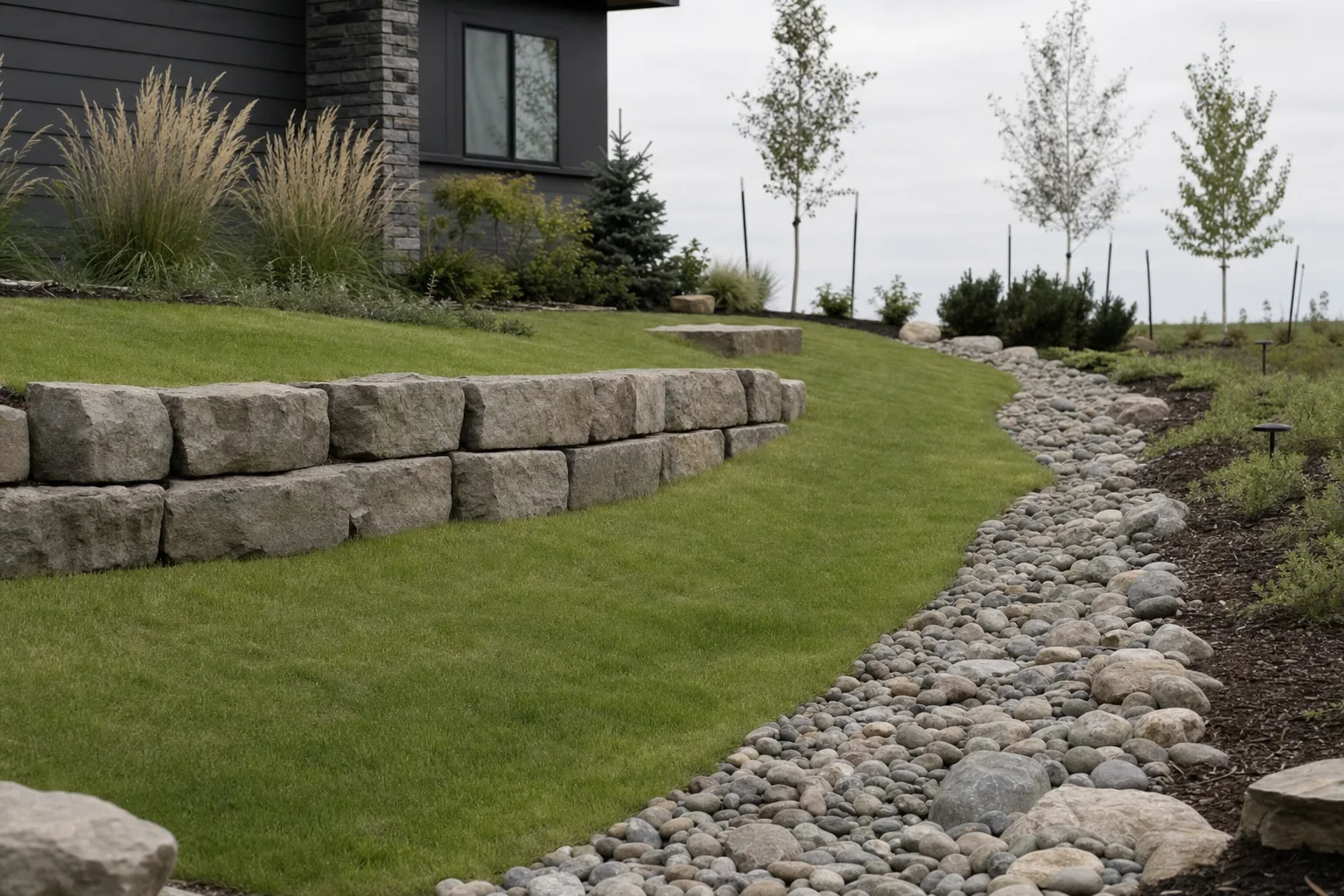 Armored channel and retaining structure on a graded slope
System thinking
Drainage, grading and erosion are not three services. They are three symptoms of the same variable: what water does on your property between the moment it lands and the moment it leaves.
Flat or reversed grade with no outlet. The lawn stays saturated, the soil at the foundation cycles wet and dry, and the fence line sits in wet ground.
Too much fall over too long a run, or too much volume funneled into too narrow a path. The slope pays for it in material.
That is why an erosion assessment includes an elevation survey and a look at every downspout, and why the fix is often a drainage change rather than a wall.
Method
There are three standard responses to an eroding slope, and all three are attempts to replace what left rather than change why it left.
Fill the rill, crown it, seed it. The new soil is loose, uncompacted and un-rooted, which makes it the most erodible material on the property. The next storm arrives at the same velocity along the same line and removes the repair first, because it is the easiest thing there to move.
Mulch is a surface dressing on a hydraulic problem. On any real gradient it floats, rafts and leaves, which is why the same bed needs it again every spring. Where mulch is genuinely the right material, it needs a bordered, flow-interrupted bed to sit in — otherwise you are buying an annual subscription to the same rain.
A retaining structure resists lateral soil pressure. It does not stop water. Build one across a slope without drainage behind the face and without addressing the flow arriving from above, and water either saturates the backfill and pushes the wall out, or runs over the top and undermines the toe. Both failures are visible within a few seasons, and a leaning wall costs considerably more to correct than it did to build.
Nothing on a slope holds unless the water is slower than the soil is strong.
We start with the contributing area, because a slope only has to survive the water that actually reaches it. Roof discharge gets collected and carried past the crest. Sheet flow off hardscape gets intercepted before it reaches the face. Concentrated discharge gets dispersed.
Then we shorten the run — reduced gradient where there is room, benches where there is not — so no single stretch lets water build velocity. Only then does armoring, matting and planting go in, and only where the design says it is needed. A slope stabilized in that order looks unremarkable for a long time, which is the entire point.
And sometimes the answer is smaller than what you asked for. If regrading eight feet of bed and rerouting one downspout solves the problem, we are not going to sell you a retaining wall to do it.
Questions
Walk the slope the day after a storm. Active erosion leaves fresh, sharp-edged rills, clean soil fans on hardscape, and undercut voids behind edging or wall faces. Old scars are rounded, colonized by weeds and stable. Fresh edges mean the slope is still losing material every rain.
Only when the geometry actually needs one. A wall holds soil back; it does not stop water from running over, behind or under it. Walls built without drainage behind the face, and without a plan for the flow arriving from above, are the most expensive erosion failures we get called to look at. Many slopes are better served by reducing the grade, terracing and interrupting flow.
Planting is a long-term stabilizer, not a first response. Seed and young plants need the surface to hold still long enough to root, which is why matting, blanket or turf reinforcement usually goes in alongside the planting. Deep-rooted species are the durable answer once the water has been slowed.
Usually because it treated the surface and left the hydraulics alone. Added topsoil, fresh mulch and a row of stone do not change the volume or velocity of water arriving at that spot. If the flow is still concentrated, it will find the same line again and take the new material with it — new fill first, because it is the loosest thing there.
They are the same water. Standing water is what happens where flow stops; erosion is what happens where flow accelerates. Grade determines which one you get. That is why we assess drainage, grading and erosion together instead of quoting them as unrelated jobs. Details are on the drainage page.
Sometimes. Taller retaining structures, work inside a drainage easement, and work near a creek or floodplain can trigger permitting or require an engineer’s design. We tell you when a project crosses that line rather than quietly building something that should have been reviewed.
Structural elements — grading, terraces, armoring, matting — are done when we leave. The planted portion takes a growing season to knit and looks thin before it looks established. We say which parts of the result are immediate and which need time, and we schedule planting for the season that gives it the best chance.
Next step
Describe what is moving and where it ends up. Photographs taken during or just after a storm are worth more than anything else you can send us, because they show where flow concentrates — which is the one thing a dry-day visit has to infer.
If soil is undermining a structure, a wall or a fence line, say so in the description. That moves ahead of routine work.
Request an erosion assessment
Tell us what is moving. We’ll tell you what is moving it.
A Sunday specialist will reach out to schedule your assessment and walk the property with you. If it’s urgent, call (817) 320-0028.
Erosion control
It took a long time to get there and it is not coming back. The cheapest moment to stop erosion is always the season before the one you are in.

Seasonal service
Each fall Sunday adds lighting to the work we already do on your property — permanent architectural systems that stay on the roofline year-round, and seasonal holiday installs we hang, service and take down for you.
All lighting installations booked before November 1. Design and quote at no charge.
Discount applies to new lighting installations scheduled between September and January. Ask us about bundling with a maintenance plan.
WAIT—DON'T PAY FULL PRICE.
Get 25% off your next Sunday project.
Drop your email below and we’ll send your offer.
New customers only. Terms apply.
YOU’RE IN.
Your 25% Sunday offer is on its way.